Is WhatsMyName.app Safe? A Balanced 2026 Review
You want to check if a username is taken across social media, forums, or gaming sites — but is WhatsMyName.app safe to use? In an era where digital footprints can reveal more than we intend, tools like this raise valid questions about privacy, security, and trustworthiness. As we navigate 2026’s evolving online landscape, with increasing scrutiny on OSINT (Open Source Intelligence) tools, it’s crucial to separate hype from facts.
This in-depth review examines WhatsMyName.app thoroughly: what it does, how it operates, its privacy and security practices, potential risks, real user experiences, and comparisons to alternatives. We’ll draw on technical details from its open-source roots, community feedback, and the current state of the tool in 2026. No sensationalism — just evidence-based analysis to help you decide if it’s legitimate for everyday or professional use. By the end, you’ll have a clear verdict grounded in how the tool actually works today.
What Is WhatsMyName.app and How Does It Work?
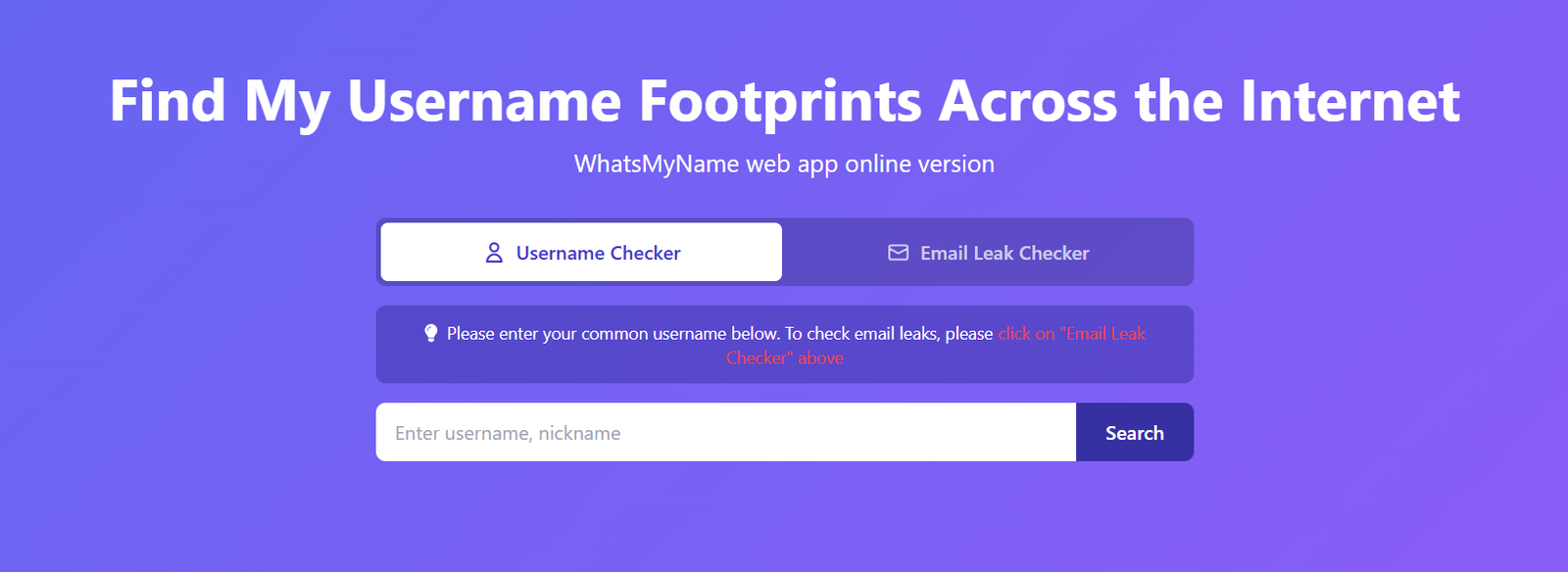
WhatsMyName.app is a free web-based username enumeration tool designed primarily for OSINT purposes. At its core, it checks whether a specific username exists on hundreds of websites, from social media platforms and forums to niche services like gaming sites, marketplaces, and professional networks. The project originated in 2015 when Micah “WebBreacher” Hoffman created it to address the high rate of false positives in earlier username checkers. Today, it’s maintained as an open-source initiative on GitHub under the WebBreacher/WhatsMyName repository, with the user-friendly web interface at whatsmyname.app developed and hosted by Chris Poulter of OSINT Combine.
The tool doesn’t “hack” or access private data. Instead, it performs public checks by simulating visits to profile URLs on target sites. You enter a username (e.g., via https://whatsmyname.app/?q=exampleuser), select filters like categories (social, forums, gaming), and it queries each supported site. Results appear as a table or icons showing “claimed,” “available,” or errors, often with direct links to profiles.
Technically, the magic lies in a JSON data file called wmn-data.json. This file contains hundreds of site-specific “detections” — rules defining the exact URL pattern for a username (e.g., https://example.com/user/{username}) and how to confirm existence (via HTTP status codes, specific text strings, or response patterns). The web app pulls the latest version of this JSON automatically, ensuring checks reflect community-submitted updates. In 2026, the data file continues to receive regular pull requests, with notable activity as recent as January 2026.
This client-server hybrid approach means your browser sends the query to the whatsmyname.app server, which handles the bulk of the requests to avoid CORS issues and rate-limiting from target sites. No registration or login is required — you can run searches instantly. Features include category filters, result exporting to CSV or PDF, and URL-based sharing for collaboration.
In practice, it’s straightforward for casual users checking their own online presence or professionals conducting investigations. However, it’s explicitly a public data aggregator, not a privacy-enhancing tool. It reveals existing public profiles but doesn’t obscure or protect your own data.
Data Sources & Accuracy in 2026
WhatsMyName.app relies entirely on publicly available information from the websites it checks. The data sources are the sites themselves: their public profile pages, username availability endpoints, or response behaviors. Contributors worldwide submit new detections via GitHub issues, pull requests, or a dedicated form, following strict inclusion criteria — sites must allow unauthenticated access, use usernames in URLs, and not remap them to internal IDs.
As of early 2026, the tool supports checks across approximately 600+ platforms (community estimates from recent OSINT discussions range from 520 to 690, with the exact count fluctuating based on JSON updates). Popular categories include social media (where supported), forums, e-commerce, gaming, and professional networks. Notably, it has limitations on mega-platforms like Facebook, Instagram, or LinkedIn, where usernames in URLs are often not customizable or publicly enumerable without authentication — a technical reality, not a flaw in the tool.
Accuracy stands out as a strength. The project was built specifically to minimize false positives, unlike some competitors that rely on generic URL checks. Detections use precise matching (e.g., confirming a 200 OK with username-specific content or absence of “not found” messages). In 2026, real-time checks ensure results reflect current site states rather than cached data. Community testing in OSINT forums consistently praises its reliability for avoiding noise — one Reddit user noted it “avoids false positives better than most.”
That said, accuracy isn’t perfect. Site changes (e.g., redesigns altering response patterns) can cause temporary misses until the JSON is updated. Rate limiting or CAPTCHA on targets can lead to incomplete results. In 2026, with ongoing maintenance, these issues are addressed promptly, but users should verify high-stakes findings manually by visiting linked profiles.
Privacy & Data Collection Practices
Here’s where many users pause: whatsmyname privacy concerns are legitimate in 2026’s data-conscious environment. The tool itself collects minimal user data. There’s no account creation, no email signup, and no persistent tracking tied to identities. Searches are anonymous by design — you don’t even need to provide personal details.
However, as a web service, whatsmyname.app’s server inevitably receives your IP address, user-agent string, and the username you’re querying with each search. The official GitHub repository and site provide no explicit privacy policy or terms detailing logging practices. This transparency gap is a double-edged sword: it reflects the project’s lean, community-driven nature (no corporate bloat), but leaves room for uncertainty.
Evidence suggests low-risk practices. Promotional descriptions from integrated tools and community discussions emphasize “zero data retention” for searches, aligning with its open-source ethos. The server performs checks on behalf of users to bypass technical hurdles, but there’s no indication of storing or monetizing query logs. Unlike data brokers, it doesn’t build user profiles or sell insights. In 2026, no reports of whatsmyname data collection scandals, breaches, or unauthorized sharing have surfaced.
Potential privacy implications arise indirectly. When the server queries target sites, those sites see traffic from whatsmyname.app’s infrastructure (often AWS-hosted, per technical scans), not your IP — which actually protects your anonymity from the targets. Your own searches, however, could theoretically be logged by the operator for abuse prevention (e.g., the tool has faced DDoS-like automation attacks leading to downtime).
For everyday use, this is comparable to using any public search engine. Power users concerned about logs can mitigate by using a VPN or self-hosting checks via the open-source JSON (pairing it with CLI tools like Sherlock). Bottom line: WhatsMyName.app isn’t harvesting or selling your data, but it’s not a zero-knowledge privacy fortress either. It’s a public aggregator — treat it as such.
Security of the Website & App
WhatsMyName app security holds up well under scrutiny. The site uses standard HTTPS encryption, protecting queries in transit. No login means no stored credentials to steal. The underlying infrastructure appears stable, with AWS elements noted in security scans, and regular JSON updates indicate active maintenance.
Known issues in 2026 are operational rather than exploitable vulnerabilities. The web app has experienced occasional downtime from abusive automation (e.g., scripted hammering of searches), as documented in OSINT communities. These are denial-of-service incidents, not breaches, and the team has responded by implementing safeguards. No public CVEs, data leaks, or malware associations exist for the official site.
Since the core data is open-source, security-conscious users can audit the JSON file or run local versions. The web interface itself is simple — no complex JavaScript that could introduce client-side risks. Browser extensions using the same data (like “Who Am I”) inherit this transparency.
Compared to paid or closed-source alternatives, its open nature allows community verification. In 2026, with rising cyber threats, this lack of hidden backdoors makes it more trustworthy than opaque apps. Still, standard web hygiene applies: avoid entering sensitive usernames if you suspect targeted surveillance.
What Real Users Are Saying
Real-world feedback in 2026 paints WhatsMyName.app as a go-to OSINT staple, with praise focused on reliability and usability. On Reddit’s r/OSINT subreddit, users frequently recommend it for “avoiding false positives,” calling it superior to noisier checkers. One thread from early 2024 (still relevant) highlighted its support for archived profiles via services like archive.org.
Complaints are practical: occasional “spinning” searches during high-load periods or downtime from abuse. A 2025-2026 forum post noted crashes in a related desktop wrapper, but the core web tool fares better. No widespread scam accusations or privacy horror stories appear in searches across Reddit, LinkedIn, or cybersecurity discussions.
Quantitative data is sparse — no official Trustpilot or App Store ratings, as it’s a niche web tool rather than a consumer app. Traffic analytics show steady use (hundreds of thousands of monthly visits), indicating sustained trust in professional circles. OSINT practitioners value its categorization and export features for investigations. Casual users report success auditing their own footprints, often discovering forgotten accounts.
Negative experiences are rare and tied to expectations: some expect coverage of every major site, unaware of technical limits on platforms like Instagram. Overall, the consensus is positive — a legit, battle-tested tool used by investigators, researchers, and security pros.
Pros and Cons of WhatsMyName.app
To summarize clearly:
| Aspect | Pros | Cons |
|---|---|---|
| Usability | Intuitive interface, no signup, fast results, filters & exports | Occasional downtime from abuse |
| Accuracy | Low false positives, precise detections | Misses on some big platforms (e.g., FB/IG) |
| Privacy | No accounts, minimal collection, open-source data | No formal privacy policy; server sees queries |
| Cost | Completely free | Relies on community maintenance |
| Features | 600+ sites, categories, real-time checks | Not mobile-optimized; no API for bulk |
| Maintenance | Active 2026 updates | Dependent on external site changes |
This balance shows a tool strong on utility but transparent about its public nature.
WhatsMyName.app vs. Alternatives
How does it stack up in 2026? Here’s a comparison with popular username search tools:
| Tool | Sites Covered | Accuracy Focus | Privacy Approach | Cost | Best For | Key Difference |
|---|---|---|---|---|---|---|
| WhatsMyName.app | ~600+ | High (low FP) | Minimal logging assumed | Free | OSINT pros, quick checks | Open-source JSON, categorized |
| Namechk | 500+ | Medium | Basic web privacy | Free/Paid | Casual username hunting | More consumer-focused UI |
| Instant Username Search | 500+ | Medium-High | Claims zero retention | Free | Broad availability checks | Simpler, less technical |
| Sherlock (CLI) | 400+ | High | Local execution | Free | Privacy maximalists | Runs on your machine, no server |
| Maigret | 2000+ | Variable | Local + some APIs | Free | Deep investigations | Broader but higher false positives |
WhatsMyName excels in accuracy and community vetting but lags behind local tools like Sherlock for ultimate privacy. Namechk and Instant Username Search feel more polished for beginners but may introduce more noise.
Is WhatsMyName.app Safe? Final Verdict
Yes, WhatsMyName.app is safe and legitimate to use in 2026 for most purposes. It’s a reputable, open-source-backed OSINT tool with a strong track record in the cybersecurity community. There are no credible reports of data selling, breaches, or malicious intent. Its design prioritizes public data aggregation without unnecessary collection, and active maintenance keeps it relevant.
That said, “safe” depends on context. For casual users auditing their digital footprint or checking availability, it’s low-risk and highly practical. Power users in OSINT or investigations benefit from its precision but should pair it with VPNs or local alternatives for sensitive work. It’s not a privacy tool — it surfaces public info, which could expose patterns if misused by others.
Potential risks are low and standard for web services: possible IP/query logging (unconfirmed but plausible for abuse defense) and ethical considerations around how results are used. In 2026, with no red flags after over a decade of operation, it earns our recommendation as trustworthy.
Practical advice:
- Use it via VPN or Tor for extra caution.
- Verify results manually.
- Self-host checks if privacy is paramount.
- Report issues via GitHub to support the community.
FAQs About WhatsMyName.app Safety
Does WhatsMyName.app sell your data? No evidence supports this. It requires no personal info and focuses on public username checks. Community descriptions stress no retention or monetization.
Is WhatsMyName.app safe for OSINT research? Yes. It’s widely used by professionals for legitimate investigations. Its open-source nature allows auditing, and results are based solely on public data.
What are the privacy risks of using WhatsMyName? Main risks are server-side visibility of your IP and query (standard for any website) and the public nature of revealed profiles. No tracking cookies or profiling reported.
Does WhatsMyName.app require an account or store searches? No account needed. Searches are ephemeral; no formal storage policy exists, but it’s designed for one-off use.
Has WhatsMyName.app had any security incidents in 2026? Only operational downtime from external abuse (e.g., automation floods), quickly addressed. No data breaches or vulnerabilities reported.
Is it better than alternatives for privacy? For serverless privacy, local tools like Sherlock win. WhatsMyName trades some privacy for convenience and accuracy via its web interface.
Can WhatsMyName.app be used on mobile? Yes, the responsive web app works on phones, though a dedicated app (if any wrappers exist) may vary in stability.
What if I find unexpected profiles using it? Review and secure or delete old accounts. It’s a diagnostic tool, not a threat in itself.
Conclusion
WhatsMyName.app remains a valuable, safe resource in 2026 for anyone needing to map usernames across the web. Its open-source foundation, community-driven accuracy, and lack of commercial overreach set it apart from riskier alternatives. While it has limitations — like incomplete big-platform coverage and the inherent openness of public searches — these are transparent trade-offs, not hidden dangers.
Final recommendation:
- Casual users: Absolutely safe and useful for self-audits or basic checks.
- Power users/OSINT pros: Trustworthy core tool; combine with local methods for sensitive cases.
- Privacy extremists: Opt for self-hosted alternatives.
In a world of data brokers and shady apps, WhatsMyName.app stands as an honest player. Use it responsibly, verify outputs, and it will serve you well. Stay informed by following the GitHub repo for updates. Your digital safety starts with understanding the tools you trust — and the evidence shows this one is worth it.